
Module 6 of the BHSA County Policy Manual writes AB 348’s presumptive eligibility criteria into the state’s core guidance for Full Service Partnerships.
On August 13, DHCS released drafts for Module 6 of the Behavioral Health Services Act (BHSA) County Policy Manual, the state’s playbook for how counties implement the BHSA. The module specifically implements language from Assembly Bill 348 (2025), a law co-sponsored by the Steinberg Institute that requires counties to prioritize California’s hardest-to-reach populations for FSP slots: those experiencing chronic homelessness, transitioning out of incarceration or institutional care, or facing repeated hospitalization.
These updates are dense and technical, but they offer a window into how the BHSA will work on the ground. This Module 6 draft includes new guidance on county reporting requirements, along with updated language across existing sections. Among the updates: adding eligibility criteria for Full Service Partnerships (FSPs): wraparound, intensive outpatient services that are proven to reduce homelessness, incarceration, and hospitalization.
Below, we break down what AB 348 does, how it fits into the BHSA’s broader priority populations, and how DHCS is applying it in other contexts through this Module 6 update.
What are Full Service Partnerships?
FSPs are intensive outpatient treatment programs for people with serious mental illness (SMI). They are built on a “whatever it takes” approach, meaning services extend far beyond traditional mental health treatment. In addition to therapy and psychiatric care, FSPs offer wraparound support like housing assistance, employment services, money management, and 24/7 crisis availability.
How FSPs work in the Behavioral Health Services Act (BHSA)
Full Service Partnerships serve as a dedicated funding category in the BHSA; counties are required to spend 35% of their BHSA funding on Full Service Partnerships. The BHSA Policy Manual provides more details on what that exactly means.
First, it separates FSPs into two distinct levels of care: Assertive Community Treatment (ACT) programs and FSP Intensive Case Management (ICM) programs.
ACT programs are globally recognized evidence-based programs that provide intensive, community-based behavioral health care to individuals with serious mental illnesses. These are considered the most intensive level of care. FSP ICM programs serve as a step-down from ACTs, offering coordinated support and intensive outpatient services.
It also lists every program that can be funded under the FSP funding category, including:
- Mental health, supportive, and substance use disorder (SUD) services
- Assertive Community Treatment (ACT) and Forensic ACT (FACT)
- FSP Intensive Case Management (ICM)
- The Individual Placement and Support (IPS) model of Supported Employment
- High Fidelity Wraparound (HFW) for children and youth
- Assertive field-based initiation for SUD treatment
- Outpatient behavioral health services for evaluation and stabilization
- Ongoing engagement services
These clarifications provide counties with the needed guidance to determine which programs and which populations they will serve using this allocated revenue.
What AB 348 Does
For too many Californians living with serious mental illness or substance use disorders, the path to accessing FSPs has been obstructed by complex eligibility criteria, fragmented systems, and bureaucratic delays. These barriers especially affect those unhoused or cycling through jails or hospitals.
AB 348, authored by Assemblymember Maggy Krell and co-sponsored by the Steinberg Institute, fixes this by establishing “presumptive eligibility” for certain individuals. It creates a fast lane into FSPs for people who meet specific, high-need criteria, without the usual prior-authorization process. For an individual to presumptively eligible for FSP programs, they have a serious mental illness and meet at least one of the following criteria:
- They’re currently experiencing unsheltered homelessness
- They’re transitioning back to the community after six months or more in a secured treatment or residential setting (including a mental health rehabilitation center, an institution for mental disease, or a secured skilled nursing facility)
- They’ve been detained under a 5150 psychiatric hold five or more times in the last five years
- They’re transitioning back to the community after six months or more in state prison or county jail
How AB 348 presumptive eligibility fits into the BHSA’s priority populations
One of the biggest shifts from the 2004 Mental Health Services Act (MHSA) to the BHSA was a much more explicit definition of who BHSA-funded services are supposed to serve, prioritizing people with the most serious mental illness and substance use disorder needs, including those at risk of or experiencing homelessness, justice involvement, or repeated hospitalization. AB 348 takes that broader BHSA population but prioritizes a smaller subset for open FSP slots.
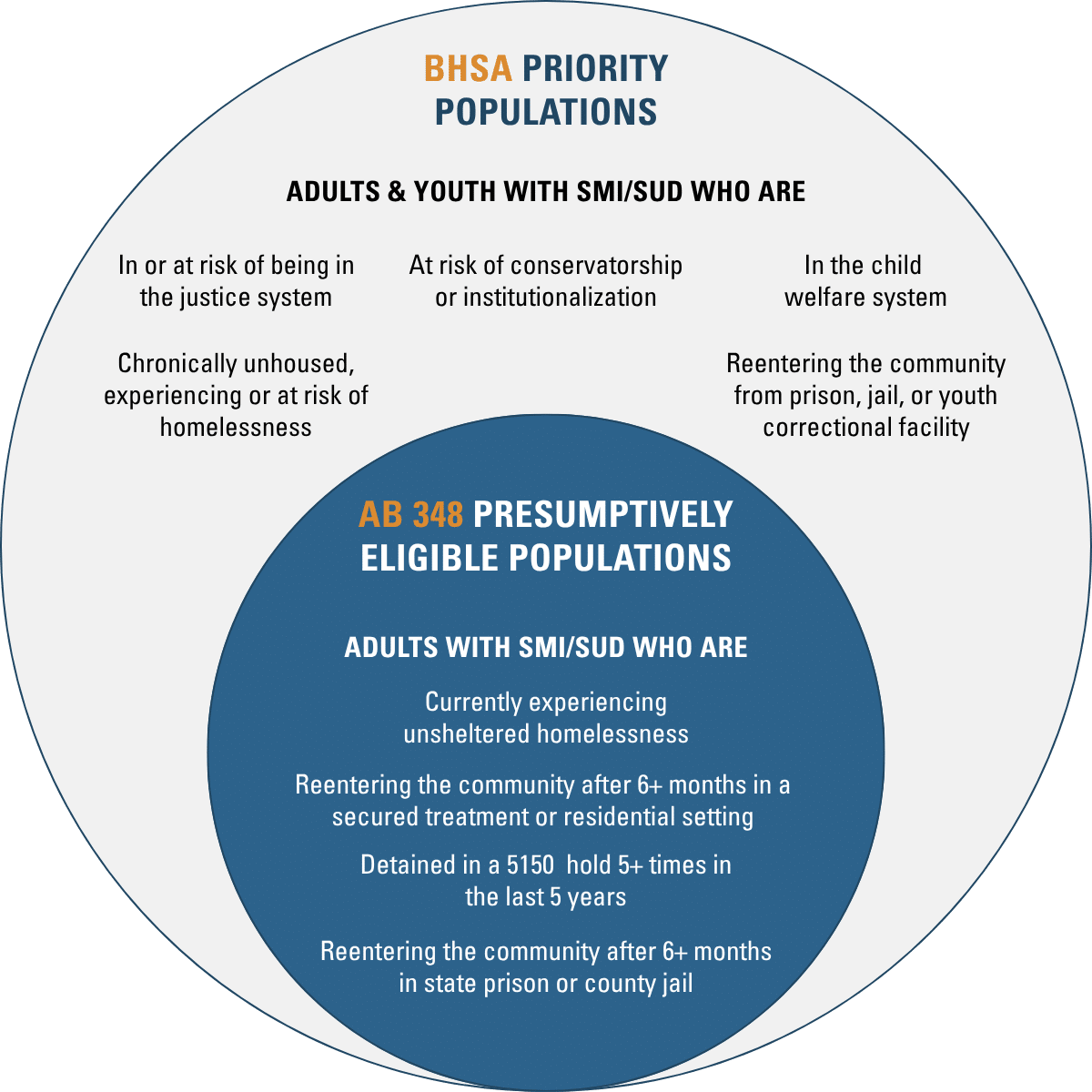
AB 348 officially goes into effect on January 1, 2027. To effectively implement AB 348, counties must update their processes and work with FSP providers to identify presumptively eligible individuals and ensure they have immediate access to FSPs.
What’s in the BHSA Module 6 update?
The changes to Module 6 of the BHSA County Policy Manual are straightforward. DHCS simply adds AB 348’s language around presumptively eligible populations into its section on Full Service Partnerships and directs counties to work with providers to build the processes needed to comply with this new law.
But DHCS also draws an explicit line between FSP presumptive eligibility and ACT programs, stating that many presumptively eligible individuals may benefit from ACTs.
This connection matters more than it might look at first glance. AB 348 doesn’t say counties have to prioritize this population if their FSP slots are already full—a reality for many counties. By explicitly tying presumptively eligible individuals to ACT, DHCS offers counties another way to prioritize these hard-to-reach populations: if standard FSP capacity is maxed out, counties now have clearer state-level backing to move presumptively eligible individuals into ACT slots instead of leaving them on a waitlist.
That’s a meaningful, practical detail for counties trying to figure out how to operationalize AB 348 by 2027.
Our TakePolicy is only as good as its implementation. AB 348 aims to ensure that people most in need of care, and our hardest-to-reach individuals get access to proven care when and where they need it. By embedding AB 348 language into BHSA implementation guidelines, this update demonstrates how DHCS expects counties to start implementing AB 348, not just for FSPs, but potentially across other evidence-based practices. Stay tuned: We will continue to share updates as more guidance is released. |