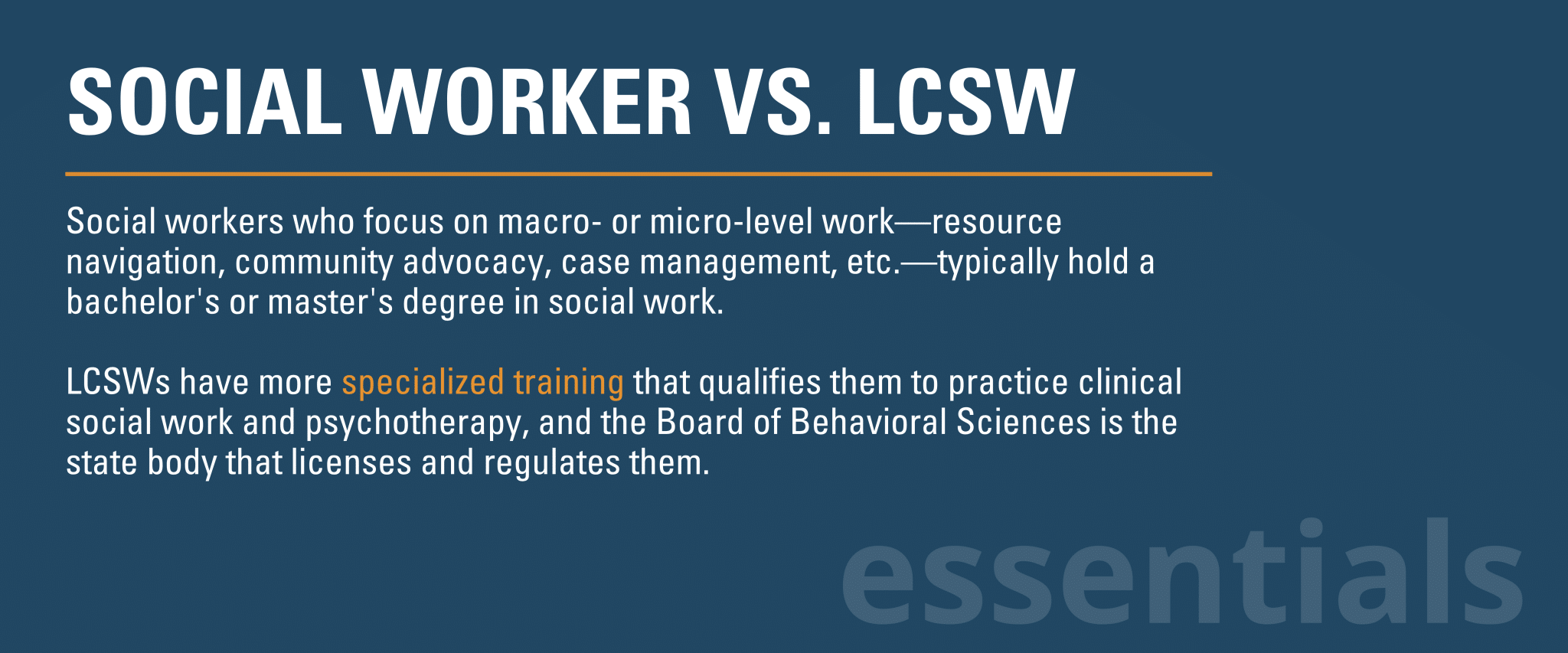
- Credentials: Becoming an LCSW requires a master’s degree in social work (MSW), 3,000 hours of supervised experience completed over at least 104 weeks, and a passing score on the Association of Social Work Boards (ASWB) clinical exam. Once those requirements are met, candidates can apply for LCSW licensure.
- Responsibilities and settings: They typically work one-on-one with clients in clinical practices, schools, hospitals, and other settings, using assessment, diagnosis, and treatment planning to help clients move toward healthier, more stable lives. As of May 2024, the median annual salary for social workers $61,330 across the country, with variations depending on the type of work social workers do.
Psychiatrists
Psychiatrists are medical doctors (M.D. or D.O.) who specialize in mental health, including substance use disorders, and are trained to evaluate both the mental and physical dimensions of a psychological condition, according to the American Psychiatric Association. Unlike therapists or psychologists, psychiatrists can order medical, laboratory, and psychological tests, and they’re able to prescribe medication. They diagnose using the APA’s Diagnostic and Statistical Manual of Mental Disorders (DSM-5), the standard reference for symptoms and diagnostic criteria.
- Credentials: Becoming a psychiatrist means completing medical school, passing a written exam for a state medical license, and then finishing a four-year psychiatry residency. According to the BLS Career Outlook, it typically takes about 12 years of education after high school to become a general adult psychiatrist, and up to 14 years to specialize in child and adolescent psychiatry. Many psychiatrists go on to pursue further specialization in areas such as forensic psychiatry, hospice and palliative medicine, addiction psychiatry, or pain medicine.
- Responsibilities & settings: Psychiatrists can work in private practices, hospitals, clinics, academic health centers, government agencies, courts and correctional facilities, and community mental health centers. Nationally, psychiatrists had a median annual wage of $269,120 as of May 2024.
Psychologists (PSY)
Psychologists are trained to help people cope more effectively with life’s challenges and mental health difficulties. Their services include psychological evaluations and psychotherapy, and they draw on evidence-based techniques—including cognitive behavioral therapy (CBT) and interpersonal therapy—tailored to a client’s specific values, goals, and circumstances, per the American Psychological Association.
- Credentials: Becoming a licensed psychologist in California requires a doctoral degree (PhD, PsyD, or EdD) along with several years of supervised clinical training overseen by the California Board of Psychology. After completing their supervised hours, candidates must pass licensing exams administered by the state. Psychologists with doctorates can also move into research, teaching, or academic roles.
- Responsibilities & settings: Many psychologists run or work in private practice, but they’re also found in academic institutions, hospitals, correctional facilities, inpatient psychiatric units, and community clinics.
Licensed Professional Clinical Counselors (LPCC)
Licensed Professional Clinical Counselors (also known as Licensed Professional Counselors) are trained to assess, diagnose, and treat mental and emotional disorders through counseling and psychotherapy. California was the last state to adopt this license through SB 788 in 2009—a bill co-authored by our founder and former Senate President pro Tempore Darrell Steinberg (D) and former Senator Mark Wyland (R).
- Credentials: LPCC must complete a master’s degree in counseling or psychotherapy. Graduates then register with the BBS as an Associate Professional Clinical Counselor (APCC) and complete 3,000 hours of supervised experience over a minimum of two years, including at least 1,750 hours of direct client work. To become fully licensed, candidates must pass the California Law and Ethics Exam and the National Clinical Mental Health Counseling Examination (NCMHCE).
- Responsibilities & settings: LPCCs provide individual, group, couples, and family counseling, and they work in community mental health centers, private practice, schools, hospitals, and outpatient clinics. It is one of the nation’s fastest growing professions, along with substance abuse and mental health counselors: the BLS projects it to grow 17% between 2024 and 2034. As of May 2024, the national median annual wage was $59,190.
Psychiatric Technicians and Aides
This role sits between clinical and non-clinical work: psychiatric technicians are licensed, while psychiatric aides are not, but both provide direct, hands-on support to people with mental illness or developmental disabilities under the supervision of psychiatrists, nurses, and therapists.
Aides help patients with daily living activities like dressing, bathing, and eating; lead recreational and therapeutic activities; observe and document patients’ behavior and condition; and support the broader treatment team. Psychiatric technicians take on more clinical responsibilities, including administering medication and monitoring vital signs.
- Credentials: In California, psychiatric technicians must be licensed through the Board of Vocational Nursing and Psychiatric Technicians (BVNPT). Licensure requires completing an approved training program of at least 1,530 hours, passing the California Psychiatric Technician Licensure Examination, and renewing the license every two years with 30 hours of continuing education. Psychiatric aides, by contrast, generally need only a high school diploma or equivalent and receive on-the-job training; some employers prefer relevant experience or a related certificate.
- Responsibilities & settings: Both roles work in psychiatric hospitals, general hospitals with psychiatric units, residential mental health and developmental disability facilities, and correctional settings. Because many of these facilities operate around the clock, technicians and aides often work nights, weekends, and holidays, per the BLS Occupational Outlook Handbook.
As of May 2024, the national median annual wage was $42,590 for psychiatric technicians and $41,590 for psychiatric aides. California pays among the highest wages in the country for psychiatric technicians, with a state median of $61,620.
Non-clinical behavioral health workers
Non-clinical roles don’t diagnose or provide psychotherapy, but they’re essential to connecting people with care and social services, building trust in underserved communities, and supporting recovery day to day.
Substance Use Disorder (SUD) Counselors
SUD counselors work with individuals and groups to support recovery from alcohol and drug use disorders, including assessment, treatment planning, education, and relapse-prevention support.
- Credentials: California doesn’t issue a state license for SUD counselors. Instead, counselors are certified through one of three state-approved bodies: the California Consortium of Addiction Programs and Professionals (CCAPP), the California Association of DUI Treatment Programs (CADTP), or the California Association for Alcohol and Drug Educators (CAADE). All SUD counselors must also register with the California Department of Health Care Services before practicing. The credential is structured as a career ladder, with requirements that scale up at each tier:
- Entry-level certification (CADC-I): No degree required. Candidates need 315 hours of board-approved education, a practicum, between 2,000-3,000 hours of supervised work experience, and a passing score on a certification exam.
- Mid-level certification (CADC-II): Requires an associate degree in a human service field along with CADC-I coursework and 2,000+ hours of supervised experience.
- Licensed Advanced Alcohol and Drug Counselor (LAADC): Requires a master’s degree and 4,000 hours of supervised experience and is the credential most closely aligned with independent clinical practice within the SUD field. All certification levels require ongoing continuing education to stay current.
- Responsibilities & settings: SUD counselors work in residential and outpatient treatment programs, hospitals, correctional facilities, and community-based organizations, often as part of a larger care team alongside clinical staff. This occupation is grouped with mental health counselors by the BLS, which reports a median annual wage of $59,190 as of May 2024 for the combined category.
California Certified Prevention Specialists (CCPS)
CCPS professionals focus on preventing substance use and related behavioral health problems before they start, working with schools, families, and communities on education and early intervention.
- Credentials: The CCPS credential is issued through CCAPP Credentialing and requires at least one year or 2,000 hours of prevention work experience, 120 hours of approved prevention-specific training, a supervised practicum, professional references, and a passing score on the IC&RC Certified Prevention Specialist exam. Maintaining the credential requires 40 hours of continuing education every two years.
- Responsibilities & settings: CCPS-certified professionals work across six core domains: planning and evaluation, prevention education, communication, community organizing, public policy and environmental change, and professional growth. They’re typically employed by county behavioral health departments, schools, and community prevention organizations.
Certified Peer Support Specialists
Peer Support Specialists use their own lived experience with mental illness, substance use, or recovery to support others going through similar challenges. Since 2022, California has recognized Medi-Cal Peer Support Specialists as an official Medi-Cal provider type through SB 803, sponsored by the Steinberg Institute.
- Credentials: To become a certified Medi-Cal Peer Support Specialist, a candidate must be at least 18, hold a high school diploma or equivalent, and have lived experience with mental illness or substance use recovery (either their own or as a close family member). Candidates must also complete an approved training curriculum covering 17 core competencies and pass a state certification exam administered through the California Mental Health Services Authority (CalMHSA).
- Responsibilities & settings: Peer Support Specialists provide services like skills coaching, recovery support, and system navigation. They can work in clinical or non-clinical settings alongside a treatment team in places like schools, hospitals, correctional facilities, and community centers.
Community Health Workers (CHWs)
CHWs (also known as promotores, community health representatives, or navigators) serve as a bridge between the community and the health and social service systems, helping people who face cultural, linguistic, or systemic barriers connect with the care they need. California added CHW services as a Medi-Cal benefit in 2022.
- Credentials: California doesn’t issue a state CHW license. According to NASHP’s state policy tracker, to bill Medi-Cal for CHW services, a worker must have lived experience connecting them to the community they serve and must qualify through either a Certificate Pathway (completing a training program covering core competencies like communication, service navigation, and advocacy) or a Work Experience Pathway (2,000+ hours of paid or volunteer CHW experience).
- Responsibilities & settings: CHWs provide health education, help clients navigate the healthcare system, and connect people to services related to chronic disease management, behavioral health, and preventive care. They typically work for community-based organizations, clinics, and county health departments, splitting their time between fieldwork and administrative tasks like documentation. In California, CHWs are also required members of CalAIM’s Enhanced Care Management, a Medi-Cal benefit for members with the most complex medical and social needs. The BLS combines CHWS and Peer Support Specialists in their salary outlook; as of May 2024, they had a median national wage of $51,030.
Case Managers
Behavioral health case managers coordinate care for people navigating mental health or substance use treatment, acting as the connective tissue between clients, providers, and community resources.
- Credentials: Requirements vary by employer, but most case manager roles call for a bachelor’s degree in social work, psychology, or a related field, with some employers requiring a Certified Case Manager (CCM) credential or licensure as a social worker or nurse.
- Responsibilities & settings: Case managers assess client needs, develop and coordinate individualized care plans, make referrals, track progress, and advocate for clients across the healthcare system. They work in hospitals, community mental health clinics, substance use treatment programs, and integrated care programs, and their role is central to team-based models like Full Service Partnerships and ACTs. Case managers are typically paid on an hourly wage, with an average base salary of $28.07 in California, according to Indeed.com.
Certified Wellness Coaches (CWC)
The Certified Wellness Coach is one of California’s newest behavioral health credentials, created through the state’s Children and Youth Behavioral Health Initiative (CYBHI) to expand access to non-clinical, pre-clinical behavioral health support for young people.
- Credentials: There are two levels of certification, each with an Education Pathway (for students or recent graduates) and a Workforce Pathway (for people already working in the field). CWC I requires an associate degree and at least 150 hours of field experience; CWC II requires a bachelor’s degree and at least 300 hours of field experience, in fields like social work, human services, or addiction studies. California Department of Health Care Access and Information (HCAI) issues the certification, which must be renewed every two years.
- Responsibilities & settings: Wellness Coaches provide non-clinical behavioral health support to children and youth through age 25, often in schools and school-linked health programs, as described by the California School-Based Health Alliance. The role is designed as both a standalone career and a stepping stone toward advanced credentials like LCSW or LMFT. As of 2026, HCAI has certified thousands of Wellness Coaches statewide, and CWC services became a reimbursable Medi-Cal benefit in 2025.