
Homelessness is one of California’s largest issues, with over 187,000 Californians experiencing homelessness—the largest in the United States. Public discourse often centers on mental illness and substance use disorder as driving factors of homelessness.
“California is home to 12% of the nation’s population, but nearly 24% of its homeless population and half of all unsheltered individuals.”
Source: Public Policy Institute of California 2025
The reality is far more complex.
Learn more about what the data show on the relationship between behavioral health and homelessness in California, why they are unable to access housing or care, and what policies and initiatives are needed to solve this crisis.
The intersection of homelessness and behavioral health in California
The most comprehensive picture of homelessness in California comes from the 2023 California Statewide Study of People Experiencing Homelessness (CASPEH), conducted by the UCSF Benioff Homelessness and Housing Initiative. It is the largest representative study of homelessness in the United States since the mid-1990s.
CASPEH highlights the bidirectional relationship between homelessness and behavioral health: Mental illness and substance use disorder increases the risk of losing housing. At the same time, the experience of homelessness can worsen or trigger behavioral health conditions. Instability, exposure to trauma, and lack of consistent treatment can further intensify symptoms and increase substance use over time. This is reflected in the data:
- 48% of study participants met the criteria for “complex behavioral health needs” (including serious mental health symptoms, frequent substance use, or recent psychiatric hospitalization)
- 51% reported severe anxiety, and 48% reported severe depression
- 35% reported regular illicit drug use
- Among those using substances, 42% reported initiating use after becoming homeless
Barriers to care and system fragmentation
Long waitlists, limited provider availability, lack of integrated services, and workforce shortages make it difficult to access timely care and meet people where they are. CASPEH data demonstrate the challenges to accessing treatment for people experiencing homelessness:
- Only 21% of those with mental health symptoms reported receiving treatment
- Only 10% of those with substance use challenges are currently in treatment
- 28% are actively seeking treatment but cannot access it
80-90% of people with severe mental illness and co-occurring SUD can benefit from permanent supportive housing when those services are available.
The fragmentation of care across systems also makes accessing treatment more challenging. Physical health care, mental health care, and substance use treatment are often delivered separately, with limited coordination between providers and housing services. A 2025 peer-reviewed study, for instance, found that care for people experiencing homelessness is often “fragmented” and reactive, rather than coordinated and patient-centered.
Data fragmentation is another barrier to coordinated care. California maintains separate data systems across programs, making it difficult to understand how people move between services. For example, the state’s Homelessness Management Information System (HMIS) captures data on individuals receiving housing and homelessness services, while behavioral health data is tracked separately through tools like the California Department of Health Care Services (DHCS)’s Mental Health Performance Dashboard and Behavioral Health Plan Dashboard. Because these systems do not meaningfully connect, we can’t see whether people experiencing homelessness are also accessing behavioral health care—making it harder to coordinate services and deliver the right support.
As a result of these barriers, people with complex behavioral health needs are more likely to experience longer periods of homelessness, higher rates of unsheltered living, and repeated interactions with emergency and institutional systems.
California initiatives and policies to address homelessness and behavioral health
While the scale of homelessness remains significant, California has seen some recent progress: state-reported data shows a 9% decline in unsheltered homelessness in 2025. But the number of people experiencing homelessness—especially unsheltered homelessness—remains high.
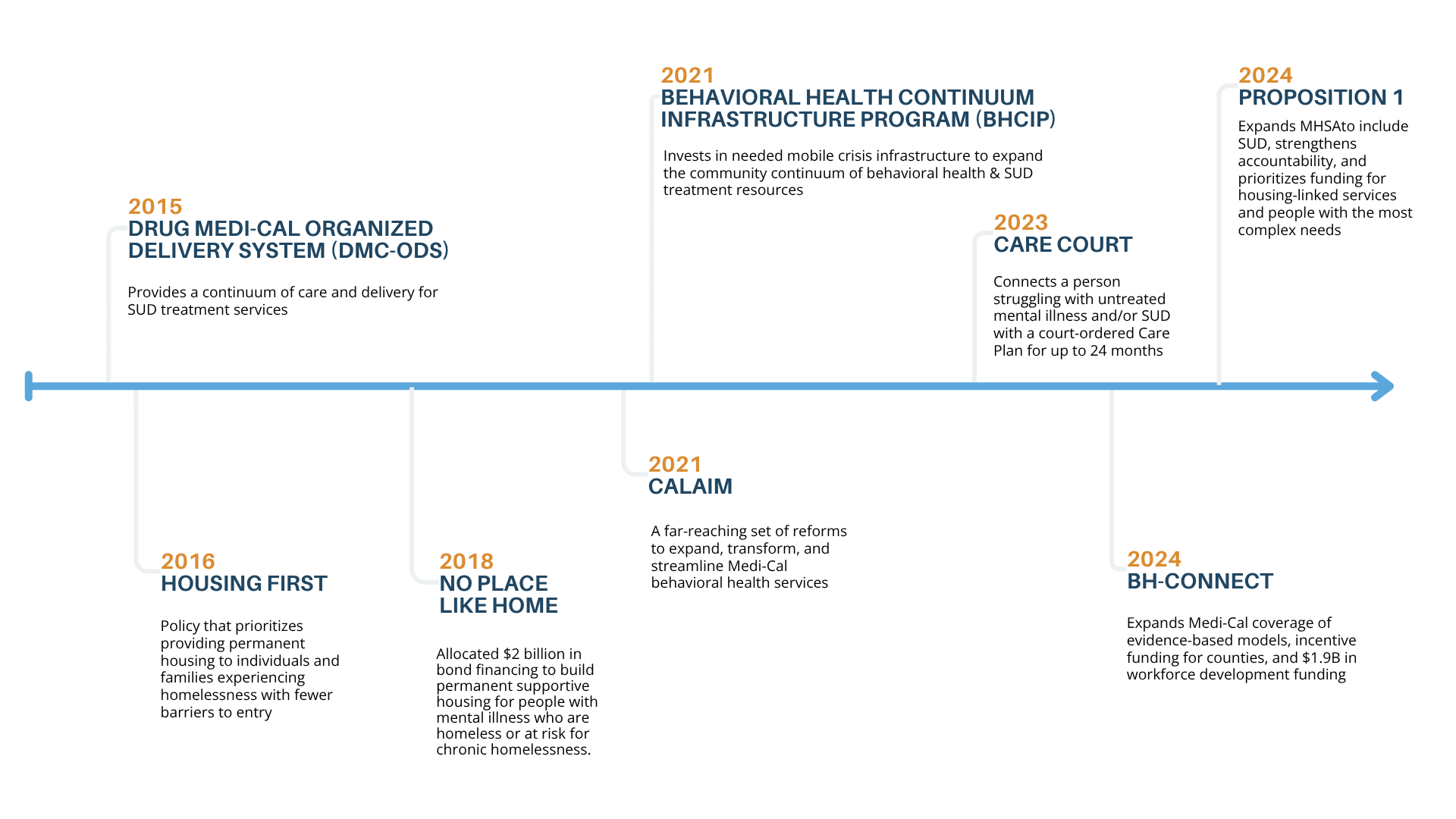
California’s policy approach has increasingly focused on connecting housing and behavioral health systems to combat system fragmentation and barriers to care. Key initiatives include:
2015: Drug Medi-Cal Organized Delivery System (DMC-ODS)
DMC-ODS is a Medi-Cal initiative that provides evidence-based SUD treatment and a continuum of care modeled after the American Society of Addiction Medicine (ASAM) Criteria® for SUD treatment services. It aims to improve coordination with other systems and care, expand access to SUD treatment, and increase the quality of care provided.
2016: Housing First
The California Legislature passed Senate Bill 1380 (Mitchell), requiring all housing programs to adopt the Housing First model. Housing First prioritizes rapid access to permanent housing without preconditions such as sobriety or treatment participation. Supportive services are offered but not required, making it a low-barrier approach for people with complex behavioral health needs. This model recognizes that stable housing is a foundation for engaging in mental health and substance use treatment.
2018: No Place Like Home Program (Proposition 2)
The No Place Like Home Program, passed by voters through Proposition 2 in 2018, allocated $2 billion in bond financing to build permanent supportive housing for people with mental illness who are homeless or at risk for chronic homelessness.
2021: California Advancing and Innovating Medi-Cal (CalAIM)
CalAIM is a major initiative to transform Medi-Cal by integrating physical, behavioral, and social health services. It includes Enhanced Care Management (ECM) and Community Supports, which connect individuals to housing navigation, tenancy services, and other non-clinical supports. CalAIM is designed to better serve people with complex needs, including those experiencing homelessness and co-occurring SMI and SUD.
One element of CalAIM is Medi-Cal Connect, a new statewide data analytics solution for population health management (PHM). It specifically addresses system fragmentation by integrating data across different sources—including Medi-Cal claims, DHCS dashboards, HMIS, and more—to create a more complete picture of how individuals interact with different systems. This more holistic view helps improve outcome measurement, strengthen care coordination, and better inform policy and program decisions.
2021: Behavioral Health Continuum Infrastructure Program (BHCIP)
BHCIP invests $1.8 billion in expanding behavioral health treatment capacity across the state, including crisis stabilization units, residential treatment facilities, and community-based care settings. Its goal is to strengthen the continuum of care in order to reduce cycles of homelessness, hospitalization, and incarceration for people with significant behavioral health challenges. In 2024, an additional $4.4 billion was allocated to BHCIP as part of Proposition One.
2022: Behavioral Health Housing Bridge Program
The Behavioral Health Bridge Program, passed in 2022 through AB 179, allocates $1.5 billion through 2027 to support temporary housing solutions (including rental assistance and tiny homes) for people with serious mental illness and substance use disorder.
2023: Community Assistance, Recovery, and Empowerment Court (CARE Court)
CARE Court established a civil court process to connect people with serious mental illness—such as schizophrenia or bipolar disorder with psychotic features—to community-based behavioral health services. Family members, first responders, and providers can petition the court to create a voluntary agreement or court-ordered care plan, which may include treatment, housing, and supportive services.
2024: Behavioral Health Services Act (BHSA) & Proposition 1
BHSA, passed as part of Proposition 1 in 2024, builds on the foundation of the 2004 Mental Health Services Act (MHSA). It expands the focus to include substance use disorder, strengthens accountability, and prioritizes funding for housing-linked services and people with the most complex needs. Proposition 1 supports these changes with additional investment in treatment infrastructure and housing (like BHCIP).
2024: Behavioral Health Community-Based Organized Networks of Equitable Care and Treatment (BH-CONNECT)
BH-CONNECT builds on CalAIM by expanding Medi-Cal coverage of evidence-based models. It focuses on improving connections between physical health, mental health, and substance use treatment systems, ensuring individuals experiencing homelessness can access consistent and integrated care.
Our TakeThe intersection of homelessness and behavioral health has real consequences for individuals and for the broader system. People with serious mental illness (SMI) and substance use disorder (SUD) are more likely to remain unsheltered, cycle through emergency rooms and jails, and face barriers to long-term recovery. Solving this challenge requires going beyond expanding housing or treatment. It requires all of California’s systems—housing, justice, behavioral health, substance use, etc.—to work together so people can access care when they need it and stay connected to services over time. California’s recent policy efforts and initiatives aim to do this, but their impact will depend on how well they are implemented in the coming years. The Steinberg Institute’s Vision 2030 initiative reflects this approach. Its focus on reducing homelessness among people with SMI and SUD targets where needs are most concentrated—and where coordinated housing and behavioral health solutions can have the greatest impact. |