
California Governor Candidates on homelessness and mental health

Nearly everyone has been impacted by mental illness or substance use. According to a 2025 California Health Care Foundation survey, 71% of Californians say mental health care is a top priority that state leaders must address in 2026.
Mental health care, homelessness, and public safety have become central to California’s policy agenda over the past several years. As California voters decide who will be their next Governor, the Steinberg Institute, Abridged – PBS KVIE, and CalMatters partnered to bring these issues to the forefront of this pivotal election.
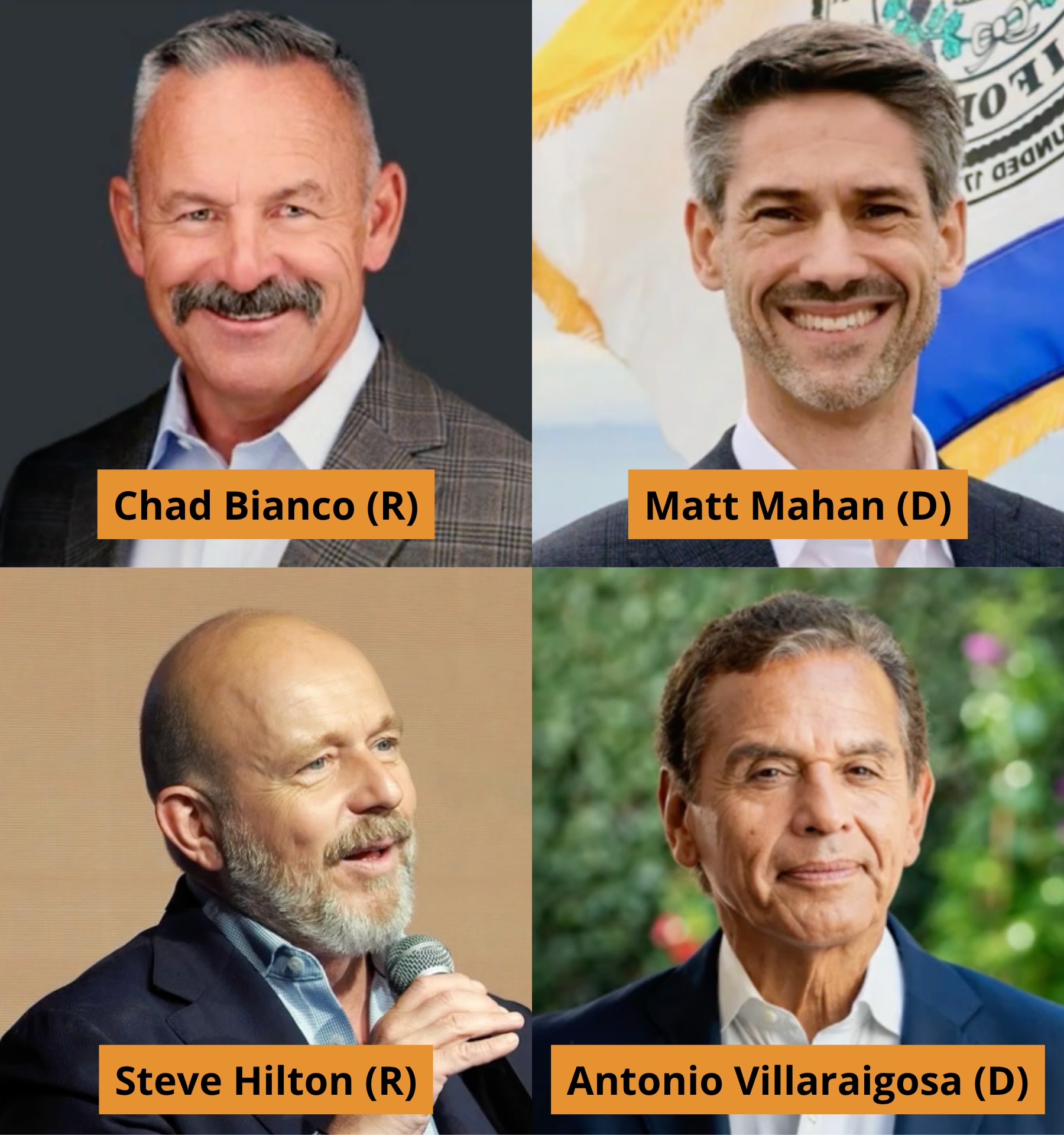
In this special segment, we bring you one-on-one interviews with four gubernatorial candidates—Hilton (R), Bianco (R), Mahan (D), and Villaraigosa (D)—to uncover how they would approach today’s biggest challenges in mental health, homelessness, and public safety.
71%
of Californians say mental health care is a top priority that state leaders must address in 2026
During Governor Gavin Newsom’s tenure, California has invested more than $16 billion in behavioral health and homelessness. Major initiatives are now underway to make the system more integrated, accessible, and accountable—but many remain in early and uneven stages of implementation.
In 2024, voters approved Proposition 1, the most significant behavioral health initiative since the 2004 Mental Health Services Act. It shifts funding toward treatment and measurable outcomes through the Behavioral Health Services Act, while also investing billions in new housing through the Behavioral Health Infrastructure Bond to expand capacity for people with serious mental illness and substance use disorders.
48%+
of people experiencing homelessness in California have complex behavioral health needs
35%
of Californians experiencing homelessness reported current use of illicit substances
67%
of Californians say the state needs to improve treatment options for serious mental illness
California is home to 12% of the nation’s population, but nearly 24% of its homeless population and half of all unsheltered individuals
At the same time, growing public frustration with encampments has intensified pressure on the state. Policies like CARE Court are intended to connect people with the most serious needs to treatment. But implementation has been uneven, and debate continues over how to balance access to care, individual rights, and public safety.
Against this backdrop, HR 1 threatens health care access for millions of Californians —500,000 Californians are expected to lose Medi-Cal coverage this year alone. That number rises to 1.8 million over the next several years.
The next Governor will be responsible for it all: implementing major reforms, addressing persistent gaps in access to care, and navigating how to maintain Medi-Cal coverage amid federal funding cuts.
How will they respond?
CalMatters’ article articulates each candidate’s platform on homelessness and behavioral health challenges facing the state based on the one-on-one video interviews.
Chad Bianco (R)
Steve Hilton (R)
Matt Mahan (D)
Antonio Villaraigosa (D)
Chad Bianco (R)
Interview highlights:
- Bianco wants to expand involuntary mental health and substance treatment for unhoused people
- He questioned the validity of widely cited research that 34% of homeless Californians regularaly used drugs – he asserted that 95% of unhoused Californians experience substance use disorder
- The real cause of homelessness, Bianco says, is drug and alcohol abuse: “They don’t need homes, they need treatment”
- He wants to “stop throwing money” at the problem, stating that he would stop housing funding to NGOs and non-profits.
Steve Hilton (R)
Interview highlights:
Hilton argued that California’s homelessness response system is wasteful, ineffective, and overly influenced by special interests.
He said the state should enforce laws against street encampments and move people indoors before connecting them to services.
California’s Housing First approach is a failure, he argued. Hilton instead called for greater investment in sober housing and treatment-focused models.
California’s lack of mental health resources has effectively turned jails into the state’s largest mental health providers, which he described as “barbaric.”
Matt Mahan (D)
Interview highlights:
- As Mayor of San Jose, Mahan highlighted San Jose’s expansion of temporary housing and tiny homes, alongside investments in homelessness prevention and permanent housing.
- He said California should pursue an “all-of-the-above” homelessness strategy that includes prevention, temporary shelter, permanent housing, ADUs, and market-rate housing.
- Mahan pledged to make California’s primary homelessness funding source permanent while tying future funding to measurable local performance outcomes.
- He supports expanding involuntary treatment standards and increasing inpatient psychiatric capacity, arguing that “the compassionate thing to do is to intervene.”
Antonio Villaraigosa (D)
Interview highlights:
- Villaraigosa said California’s top homelessness priority should be building more housing, including lower-cost options like tiny homes.
- He emphasized that homelessness policy should balance compassion with addressing visible street disorder and growing public frustration.
- Villaraigosa said he would continue homelessness funding only if cities and counties met clear accountability metrics and demonstrated measurable outcomes.
- He also called for stronger oversight of CARE Court implementation, expanded involuntary treatment standards, and greater investment in California’s mental health workforce and parity enforcement.
CalMatters, in partnership with the Steinberg Institute and Abridged by PBS KVIE, sought to interview the eight top-polling candidates for governor on these crucial themes. Candidates Tom Steyer (D), Xavier Becerra (D), and Katie Porter (D) either did not respond or declined to participate.