
California's 988 Suicide & Crisis Lifeline
The Miles Hall Lifeline Act (Assembly Bill 988) established needed funding for the 988 crisis care continuum to ensure every Californian in crisis has someone to call, someone to come, and somewhere to go.
If you or someone you care about is facing a mental health crisis, call or text 988 for support.
In 2020, the federal government enacted the National Suicide Hotline Designation Act of 2020, establishing 988 as the new three-digit alternative to 911 for urgent mental health crisis response.
Under this Act, states were required to create an implementation framework for receiving and responding to 988 calls before the lifeline’s launch in July 2022.
The Miles Hall Lifeline Act: Change born from tragedy

23-year old Miles Hall was diagnosed with a schizophrenic disorder as a teenager. His mother, Taun Hall, had spoken to police officers about her son numerous times over several years, hoping that if their paths were to cross, they would keep Miles safe.
So when Miles was in an acute mental health crisis on a summer afternoon in 2019, she called the non-emergency police line for help. Within minutes of arriving, officers shot and killed him.
Miles’ story is not unique. Families across California know the fear of calling for help and not knowing if their loved one will survive the response. Too frequently, law enforcement is the initial response to mental health crisis calls, often putting people in crisis in a vicious cycle of jail, emergency rooms, and the street, instead of getting the help they need.
After his death, Miles’ family turned their grief into action, launching a movement to prevent future tragedies. Their advocacy helped inspire legislation that would reimagine how California responds to mental health emergencies: Assembly Bill 988.
Someone to call, someone to come, somewhere to go
Assembly Bill 988 (Bauer-Kahan), also known as the Miles Hall Lifeline Act, was signed into law by Governor Gavin Newsom in 2022. Co-sponsored by the Steinberg Institute, this legislation represents one of the most significant national efforts to replace a law enforcement-first approach with a public health model for mental health crises.
988 ensures that everyone experiencing a mental health crisis has someone to call, someone to come, and somewhere to go. Now, instead of defaulting to 911 and risking a law enforcement response, friends, family members, or bystanders can dial 988 to connect someone in crisis to trained mental health professionals.
First-of-its-kind implementation and funding framework
AB 988 is unique in that it developed a 5-year implementation framework and sustained funding for the entire crisis continuum of care.
- Implementation timeline: As part of AB 988, the California Health and Human Services Agency (CalHHS) developed a 5-year implementation plan to have a comprehensive crisis system by 2025
- Sustained funding: AB 988 established a monthly fee on mobile phone and landline bills—similar to a fee charged for 911—to fund the 988 system
Since launching in 2022, AB 988 has connected millions of Californians in crisis.
1.5M
988 calls answered in California since launch
(Jul 2022 – Jul 2026)
$180M+
Annual revenue generated to fund the 988 crisis continuum
11%
Reduction in suicide mortality in young people after 988 launch
(Jul 2022-Jul 2024)
Reducing hospitalization and incarceration for Californians in crisis
In 2023, we launched the Vision 2030 initiative to address the mental health and substance use humanitarian crisis gripping California and to get people the help they need. It outlines four ambitious goals to ensure Californians with serious mental illnesses and substance use disorders get compassionate, timely care—reducing incarceration, hospitalization, and homelessness for people with serious mental illnesses and substance use disorders; and strengthening our workforce to ensure we have the capacity to serve.
How AB 988 helps advance Vision 2030
AB 988 directly addresses two of our Vision 2030 goals: reducing incarceration and hospitalization.
Specifically, it reduces reliance on law enforcement by integrating and expanding three key pillars of a comprehensive crisis care continuum across California counties:
- 24/7 access to crisis counseling through call, text, and chat
- The deployment of mobile crisis teams, staffed by trained mental health professionals and peers, to respond to crises instead of law enforcement
- Access to crisis receiving and stabilization services, so that individuals in a mental health crisis aren’t left to languish in our emergency rooms and jails
Vision 2030 Goals
Build our workforce
Modernize and strengthen California’s behavioral health workforce to meet the diverse needs of the entire state.
reduce homelessnesss
Reduce the number of unhoused people with mental illness or substance use disorders by half.
reduce incarceration
Reduce the number of people with mental illness entering our criminal justice system by half.
reduce hospitalization
Reduce the number of people entering hospital emergency departments due to behavioral health crises by half.
Creating long-term accountability and efficiency for AB 988
988 Crisis Lifeline launches
AB 988 selected for Outcomes Review Committee
AB 988 is signed into law
AB 2093 introduced in Assembly
Strengthening California's crisis response system
The Legislature made a commitment through passing AB 988: to build a comprehensive behavioral health crisis response system: someone to call, someone to come, and somewhere to go.
As implementation has moved forward, several challenges have emerged that cannot be solved administratively alone: unclear statewide leadership and accountability, gaps in coordination between 988, 911, and mobile crisis teams, and funding processes that make it difficult to plan for future demand and system growth.
That’s why the Steinberg Institute is co-sponsoring AB 2093 (Bauer-Kahan, 2025)—a targeted cleanup bill that responds directly to lessons learned during implementation and addresses problems that cannot be fully resolved without statutory changes. By providing the governance, coordination, and planning tools needed to carry out the Legislature’s original intent, this bill ensures California can fully deliver on the promise of someone to call, someone to come, and somewhere to go.
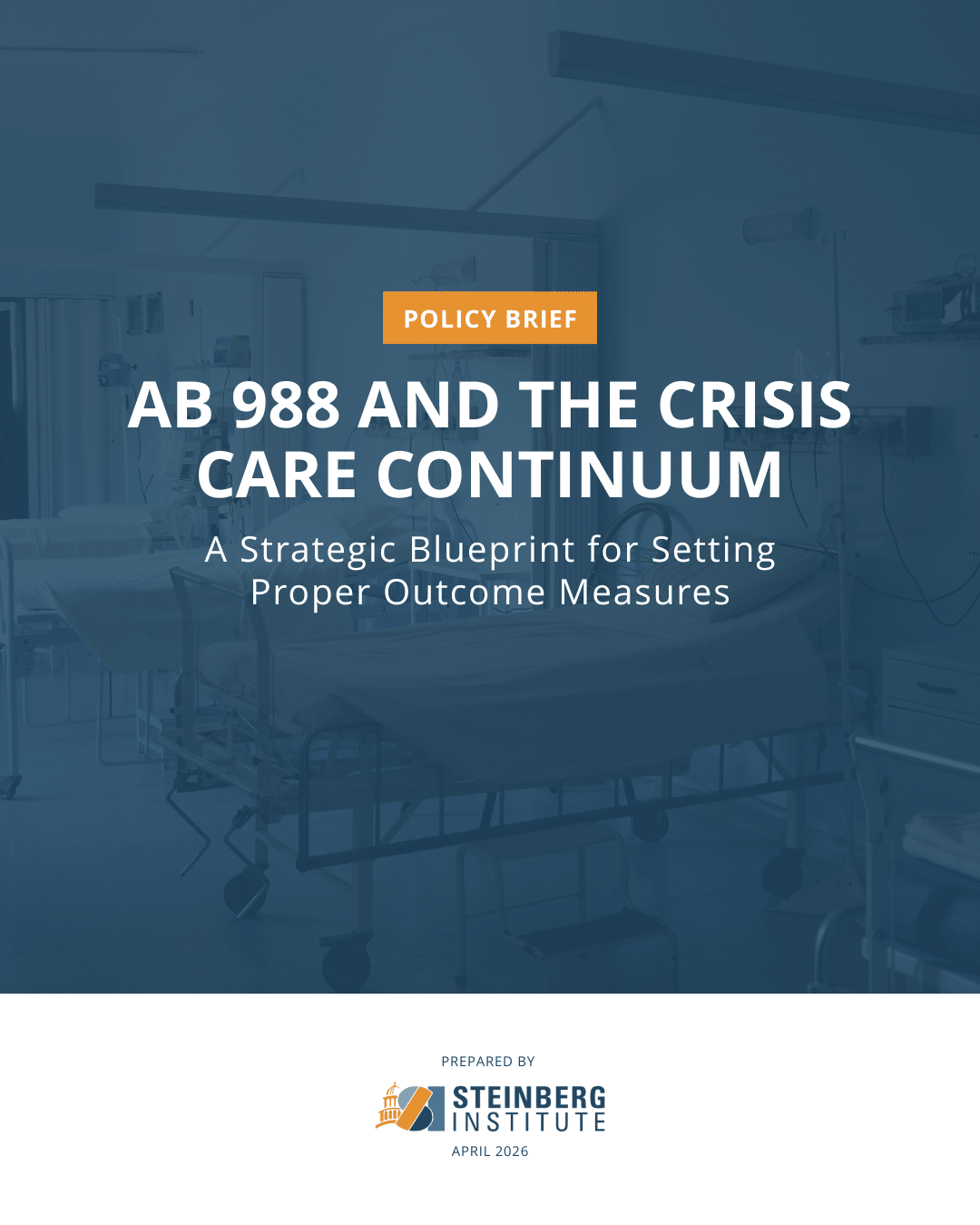
AB 988 and the Crisis Care Continuum: A Strategic Blueprint for Setting Proper Outcome Measures
The goals of AB 988 go beyond a crisis line. It aims to create a system where there is someone to call, someone to come, and somewhere to go. That means:
- Provide rapid access to trained professionals
- Connect individuals in crisis with the right services at the right time
Building on recommendations from the state’s 988-Crisis Policy Advisory Group (PAG), this policy brief provides a strategic blueprint for effectively measuring the success of 988. The measures outlined in this brief move beyond operational call center metrics and measures people-focused outcomes, efficiencies in connecting individuals to care, and more.
California just took a step to improve and strengthen its 988 crisis care continuum. Here’s what that means.
Since launching in 2022, the 988 Suicide & Crisis Lifeline has connected over 1 million Californians to needed support, with monthly calls doubling and counselors de-escalating situations that once would have resulted in police response. But implementation challenges have prevented California’s crisis response system from reaching its full potential. To
Steinberg Institute applauds Senate and Assembly support for mobile crisis, backs Assembly plan to align 988 funding with 988 response
The Assembly’s 2026-27 budget plan, released today, allocates $125 million from the 988 State Suicide and Behavioral Health Crisis Services Fund to fund mobile crisis teams dispatched through 988 centers.
Our Take: Governor Newsom’s May Budget Revision continues to put 988 and mobile crisis response at risk
The May Budget revision appears to maintain the January budget proposal to make mobile crisis programs an optional benefit, putting the future of these critical crisis services at risk.
AB 988 and the Crisis Care Continuum: A Strategic Blueprint for Setting Proper Outcome Measures
This policy brief identifies 988 outcomes measures that move beyond operational call center metrics and measure people-focused outcomes, efficiencies in connecting individuals to care, and more.
AB 988 selected for Outcomes Review: Strengthening accountability for California’s crisis response systems
Assembly Bill 988, the law that established and funded California’s 988 Suicide and Crisis Lifeline, has been selected for a formal legislative Outcomes Review as part of a new initiative to evaluate how effectively recently enacted policies are working in practice. The review will focus on implementation: what’s working, where gaps remain, and what it will take to ensure Californians in crisis can access the right care at the right place and time.
Our Take: Governor Newsom’s 2026-27 Budget protects behavioral health investments, but federal cuts threaten 988 crisis response
When enhanced federal Medicaid funding expires in 2027, mobile crisis response may become an optional benefit—shifting costs to counties and putting service continuity at risk across California. Governor Gavin Newsom’s 2026-27 budget, released today, reflects a continued focus on implementing California’s historic behavioral health investments and sustaining reforms already underway.
If you or someone you care about is facing a mental health crisis, call or text 988 for support.