
This blog is part of Perspectives, our blog series where Institute leaders, partners, and subject matter experts share their insights on the most pressing challenges — and opportunities — in behavioral health and substance use care.

The term “inflection point” is used (probably too often) to describe transformational moments. In mathematics, it’s the point on the curve where the line changes. It’s always worth noting that the line doesn’t always go up.
A closer examination reveals that inflection points are “turning point” moments that also present great risk.
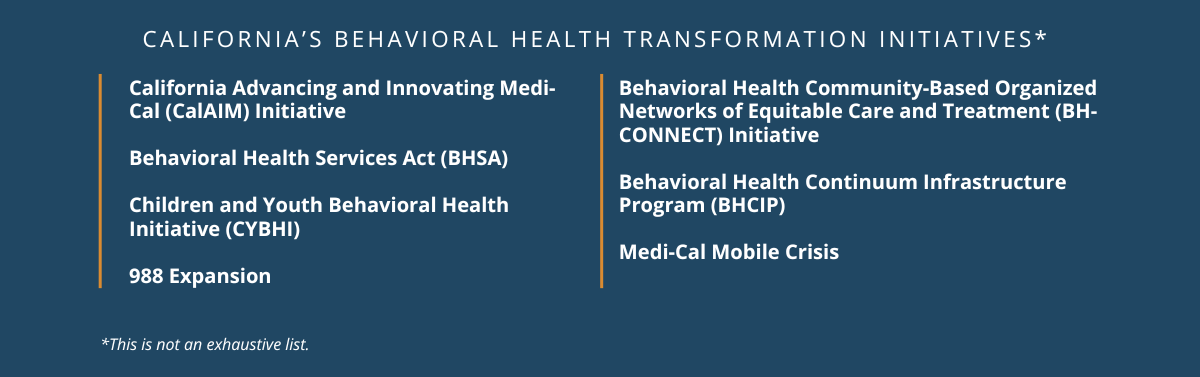
California has spent the last several years pushing some of the most ambitious behavioral health reforms in the country. New investments have reshaped crisis response, expanded services for youth, transformed county systems, and centered effective treatment methods.
But at this inflection point for California’s mental health and substance use systems, federal program cuts and a significant state budget deficit pose major threats.
To be clear, the progress made to date is impressive: stronger Medi-Cal behavioral health benefits, historic capital investments through BHCIP, a statewide 988 crisis line, major workforce initiatives, some of the strongest parity regulations in the U.S., and the passage of Proposition 1, which reorients billions toward housing, treatment, and care.
Federal threats to our behavioral health system
It seems like every week a new concern emerges: federal threats to Medicaid funding, essential health benefits, parity enforcement, and behavioral health treatment standards.
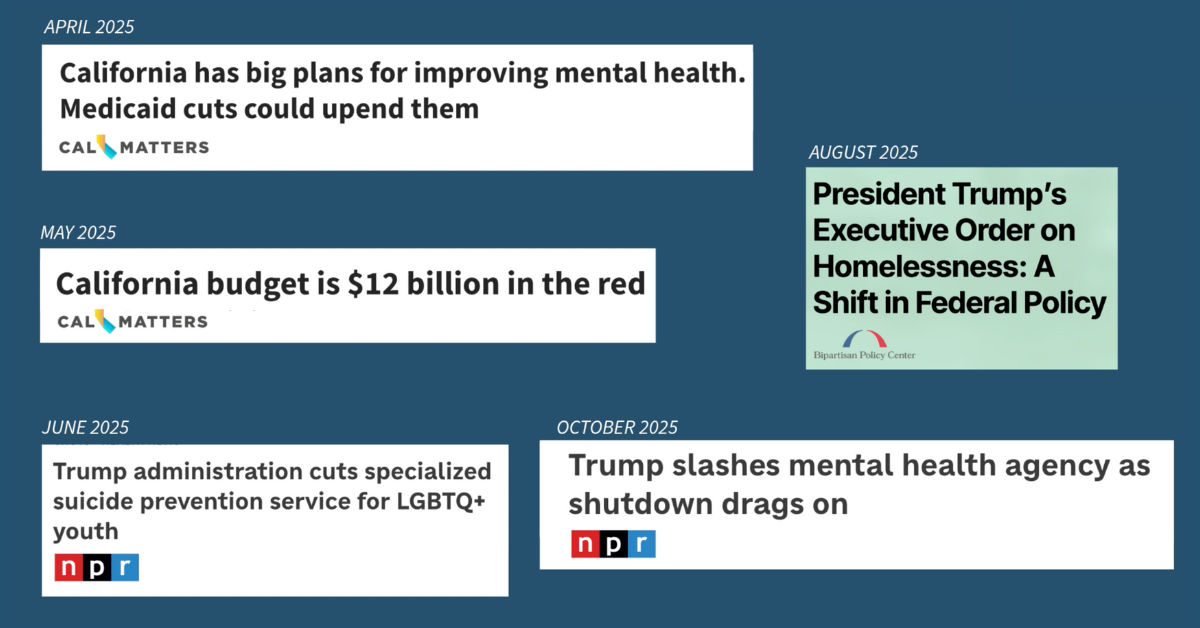
The federal administration’s Big “Beautiful” Bill (H.R. 1) proposes cutting roughly $1 trillion from Medicaid over the next decade. Because Medi-Cal is the backbone of California’s public behavioral health system, reductions of this scale would threaten the very foundation of care. An industry brief from the California Budget & Policy Center outlines how these cuts could destabilize behavioral health services across the state—particularly for people with serious mental illness and substance use challenges. Lower Medi-Cal enrollment would mean fewer reimbursements for counties and providers, undermining the community-based services Californians rely on.
We must stand firm.
Just as the state’s behavioral health leaders didn’t wait for approval from the federal government to move forward with robust reforms, we must not yield when those reforms are threatened.
The Steinberg Institute team has made protecting our progress our top priority through our Vision 2030 initiative. We do it through our continued advocacy for impactful behavioral health policies, research on the challenges facing the behavioral health workforce, and implementation partnerships to help county behavioral health teams effectively implement new policies.
And one thing is clear: we are most impactful when we work together.
Protecting our progress
At a moment when California’s historic investments in behavioral health are intersecting with federal setbacks, protecting our progress requires collective action. Even as Washington signals cuts and policy rollbacks, we must stay focused on developing practical strategies that preserve access to care and ensure our reforms continue to take root in communities across the state.
Our first ever Vision 2030 Solution Symposium in February brought together leaders from across the spectrum to define ideas and strategies for tackling the challenges facing our systems of care. Building on the success of our inaugural event, we are planning our second annual symposium, with a timely theme: Protecting our Progress.
This convening is designed to bring together diverse perspectives—providers, policymakers, payers, advocates, and system leaders—to strategize around both immediate threats and long-term implementation needs. For example, one panel will feature a provider, a state legislator, and a Medi-Cal director discussing what protecting access looks like from their vantage points, and what coordinated action is required.
We know who stands to lose the most from federal cuts: Californians with the highest levels of need. That’s why several sessions will center on the areas where the stakes are greatest—homelessness (with roughly 75% of unhoused Californians covered by Medi-Cal), parity enforcement, and the criminalization of substance use. The symposium will also explore the growing role of technology and public-private partnerships in helping fill gaps left by shrinking federal support.
If California’s behavioral health transformation is important to you, I encourage you to join us. On February 4, 2026, leaders, advocates, and care providers will gather in Sacramento for a day focused on solutions, collaboration, and action.
2025 comes to a close with a good deal of concern about what’s next for the Golden State. But if history is any guide, bet on this inflection point leading to great things. Most importantly, let this moment be our opportunity to finally ensure systems of care that rise to the challenge and offer quality care and a path to recovery for all who need it.
