
Across California, access to behavioral health care remains a real challenge, driven by workforce shortages, uneven provider availability, and too few service slots to meet demand. But even when care is available, counties face another structural issue that can make recovery harder: gaps between levels of care.
Placer County is addressing one of those gaps with the launch of a new behavioral health level of care, Mid-Service Partnerships (MSPs). The new model fills a long-standing gap between lower-intensity clinic services and the state’s most intensive program model, Full Service Partnerships (FSPs), offering a more precise option for people whose needs fall in between.
How levels of care are structured in California’s public mental health system
California’s public mental health care system is organized under two overarching systems:
- Managed Care Plans (MCPs): serve people with mild to moderate mental health needs
- Specialty Mental Health Services (SMHS): serve people diagnosed with serious mental illness (SMI) who meet certain medical criteria
Within California’s Specialty Mental Health Services system, counties offer multiple levels of care for people with serious mental illness. These levels vary in intensity, service frequency, and caseload size, giving counties flexibility to design programs that meet local needs. More intensive program models, including Full Service Partnerships (FSPs) and Assertive Community Treatment (ACT), provide high-frequency, wraparound support for smaller caseloads.
In Placer County, SMHS services historically operated at two very different intensity levels. At one end, clinic services provide lower-intensity support, often with monthly contact. Clinicians typically carry large caseloads, averaging around 80 clients per clinician, and focus on care coordination, housing assistance, medication support, and promoting independence.
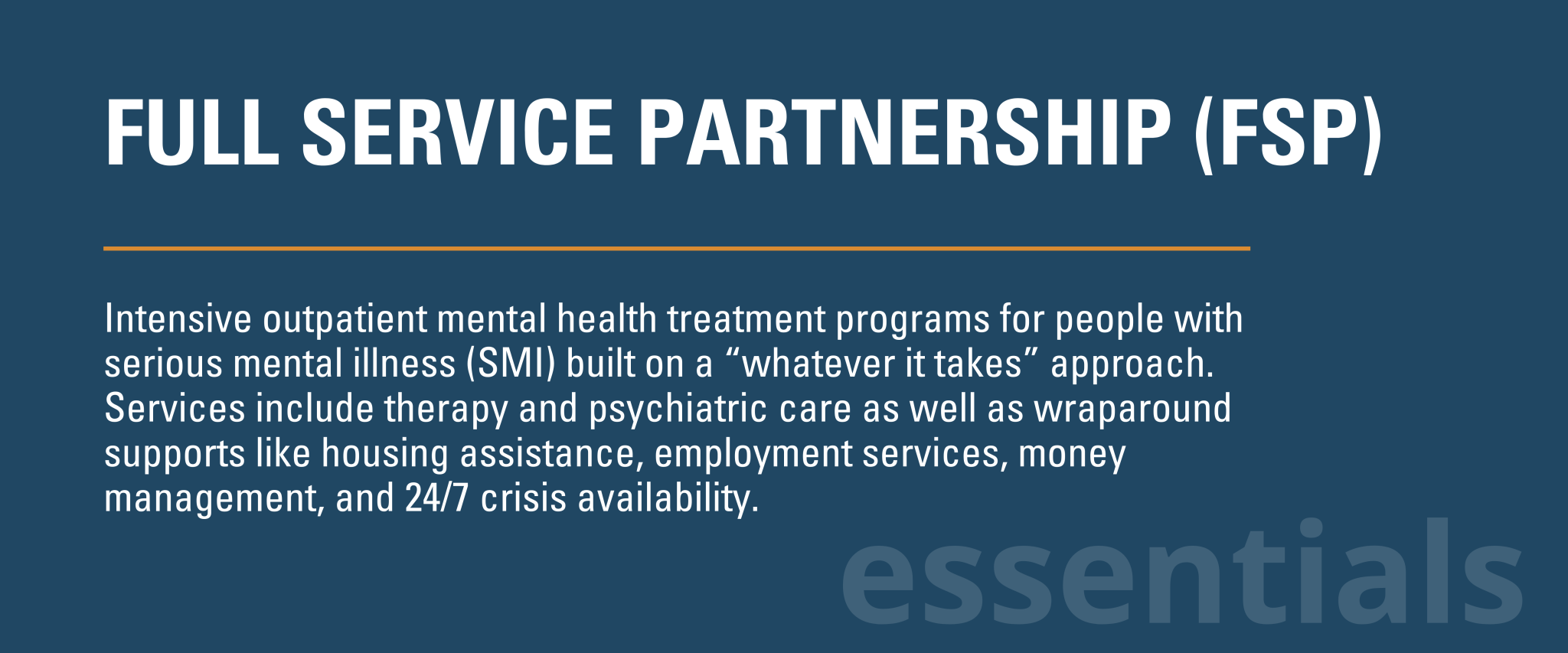
At the other end, Full Service Partnerships deliver highly intensive, wraparound care. FSP clinicians serve about 10-12 clients weekly, with more frequent contact as needed. Services emphasize intensive case management services (ICMS), crisis support, with the goal of reducing hospitalizations and psychiatric emergencies.
But Placer County recognized a sizable gap for people whose needs exceeded what clinic services could reasonably provide, while not rising to the level of intensity required for an FSP. Without a middle option, people were often placed in services that did not quite fit their current level of need.
The solution: Mid-Service Partnerships
Mid-Service Partnerships were designed to fill that space. MSPs serve individuals who require more consistent and coordinated support than clinic services offer, while avoiding the intensity and resource demands of FSPs. Clinicians in MSPs carry caseloads of roughly 40 clients, allowing for more individualized attention and flexibility.
Placer County’s New SMI Levels of Care
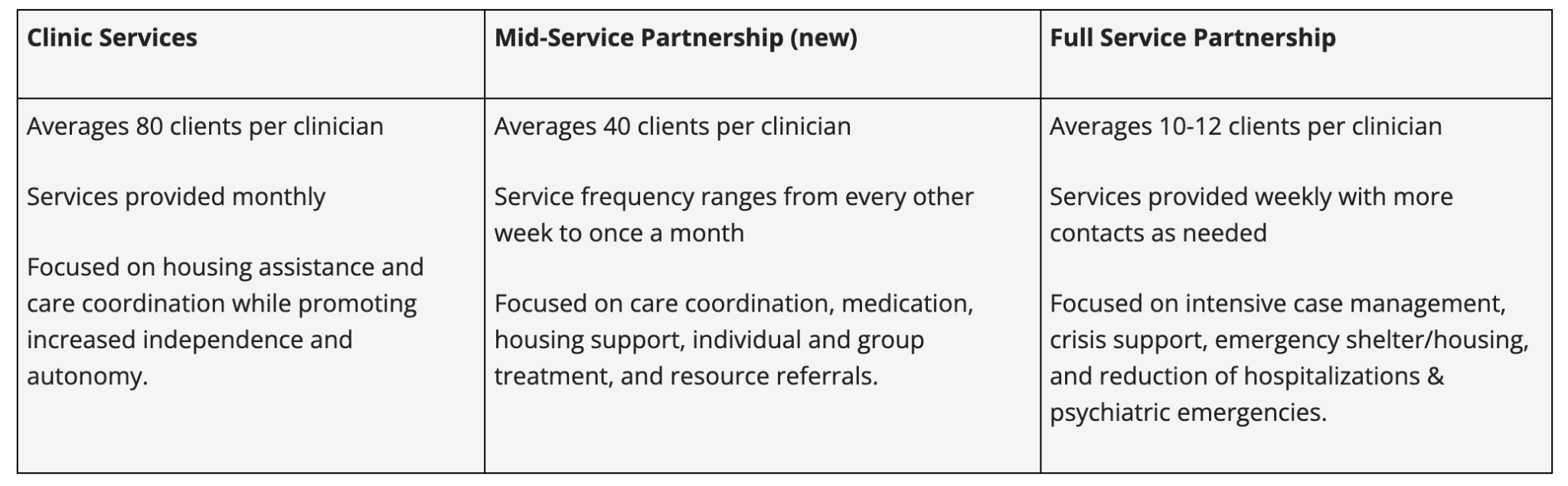
Service frequency typically ranges from every other week to once a month, with a focus on care coordination, medication management, housing support, individual and group treatment, and referrals to community-based resources.
By introducing MSPs, the county created a clearer pathway within SMHS, allowing people to receive care that better matches their needs as they stabilize, recover, or require additional support.
Level of care challenges persist across California’s mental health system
While Placer County’s solution is unique, the challenge it addresses is not.
In recent Steinberg Institute research examining how counties across California determine levels of care for people with serious mental illness, we found that gaps in care intensity are a common challenge across the state. The research, which included interviews with eight California counties representing roughly 50% of the state’s adult population, focused on how counties assess needs and place people with serious mental illness into appropriate levels of care.
Across those interviews, county leaders consistently described how gaps in care can disrupt recovery and strain systems, even when services are technically available.
“We recognized there was a big gap between Full Service Partnerships and clinic services. There was nowhere for people to step down to or step up that didn’t really need FSP.”
— Placer County
Placer County’s gap emerged within SMHS, between lower-intensity clinic services and highly intensive FSPs. But those gaps show up in different places across the continuum. Other counties described different versions of the same problem:
- Los Angeles County identified a large gap in care intensity between residential treatment programs and outpatient programs like FSPs and ACT, creating challenges for individuals who are clinically ready to step down but still need more support than outpatient services can provide.
- Mono County described how limited availability of high-quality providers can result in people staying in higher levels of care longer than necessary. When step-down options are inadequate, clients may abandon care or remain in programs that exceed their needs.
- San Mateo County highlighted how comorbidities, including substance use disorder, can lead to people being placed in the wrong level of care. County leaders also described situations where medication stabilization improves someone’s condition, making them no longer eligible for a higher level of care, even though stepping down leaves them “kind of in the wrong place.”
Together, these examples underscore a statewide reality: gaps in care are common, but they do not look the same everywhere. Placer County’s MSP model offers a targeted, practical response to the gap the county identified within its own system.
Our TakeThe Steinberg Institute’s Vision 2030 Initiative is focused on reducing hospitalization, incarceration, and homelessness for people with serious mental illness or substance use disorders. Ensuring that individuals are placed in the right level of care is a critical part of that goal. When levels of care are aligned with people’s needs, individuals are better supported as they stabilize or recover. Intensive programs can focus on those who need the highest level of support, and transitions between services become clearer and more predictable. By creating a clearer middle pathway through Mid Service Partnerships, Placer County is strengthening continuity of care and reinforcing a more responsive, sustainable behavioral health infrastructure. As California continues to implement major behavioral health reforms, Placer County’s approach offers a practical example of how counties can identify specific gaps in their systems and design solutions that improve continuity, efficiency, and outcomes across behavioral health care. |