
A new national report from Inseparable underscores the urgency and the opportunity for California to strengthen its behavioral health workforce
National advocacy organization Inseparable recently released The Workforce Report: Bridging the Mental Health Care Gap, a comprehensive look at the scope of the national shortage, policy solutions, and state-by-state snapshots of progress and gaps.
For California, the takeaway is clear: we are moving in the right direction, but the scale of the workforce challenge requires faster, more coordinated action. Steinberg Institute research shows that California must double its behavioral health workforce in the next five years to meet demand.
Our workforce shortage sits at the center of every behavioral health reform effort underway in the state. From the Behavioral Health Services Act (BHSA) to CalAIM, California has made significant investments to transform its systems. But those reforms can only succeed if we strengthen and better support the workforce responsible for delivering care.
“You can’t imagine doing everything we’ve set out to do without the workforce…We just have a lot of need, and I think the coupling of deeper partnerships among all of you, but I’m going to be very clear about the county and the state, and strengthening that partnership—as well as bringing together important implementation tools, whether that’s expanding the workforce or making our data and analytics smarter and better.”
Dr. Mark Ghaly at the Institute’s 2026 Solution Symposium
Below, we highlight what Inseparable’s report shows nationwide, how California compares, and where there is opportunity to build a stronger, more supported behavioral health workforce.
A systemic national challenge
The report makes clear that workforce shortages are one of the primary barriers to accessing behavioral health care nationwide. Nearly half of Americans live in areas with a shortage of mental health professionals, and millions go without treatment entirely.
When care is unavailable, emergency departments and jails too often fill the gaps. California’s recent reforms aim to address these challenges, but they depend on a robust workforce to meet growing demand.
The full scope of national and state behavioral health workforce policy
One of the most valuable aspects of the Inseparable report is its comprehensive view of what it takes to build a strong behavioral health workforce. These challenges are not driven by a single issue—training pipelines, payment structures, system design, and burnout all contribute to workforce shortages. The report also goes a step further by outlining a set of interconnected policy areas that must work together:
- Developing the Pipeline
-
-
- Modernizing education and training
- Reducing financial barriers through scholarships and loan repayment
- Expanding roles for non-licensed clinicians, including peers and paraprofessionals
-
- Bolstering the Existing Workforce
-
-
- Ensuring fair reimbursement
- Expanding integrated care models
- Streamlining licensing
- Supporting provider wellbeing
-
- Harnessing Data and Technology
-
- Improving workforce data collection and transparency
- Expanding telemental health and technology-enabled care
California’s snapshot: progress and persistent gaps
The California snapshot highlights both meaningful progress and ongoing challenges.
California has taken important steps:
- Medicaid reimbursement for youth peer services
- Telemental health parity in commercial insurance
- Public reporting on workforce supply and distribution
- Reimbursement rates for psychiatrists and therapists that are closer to parity with medical providers
But significant gaps remain:
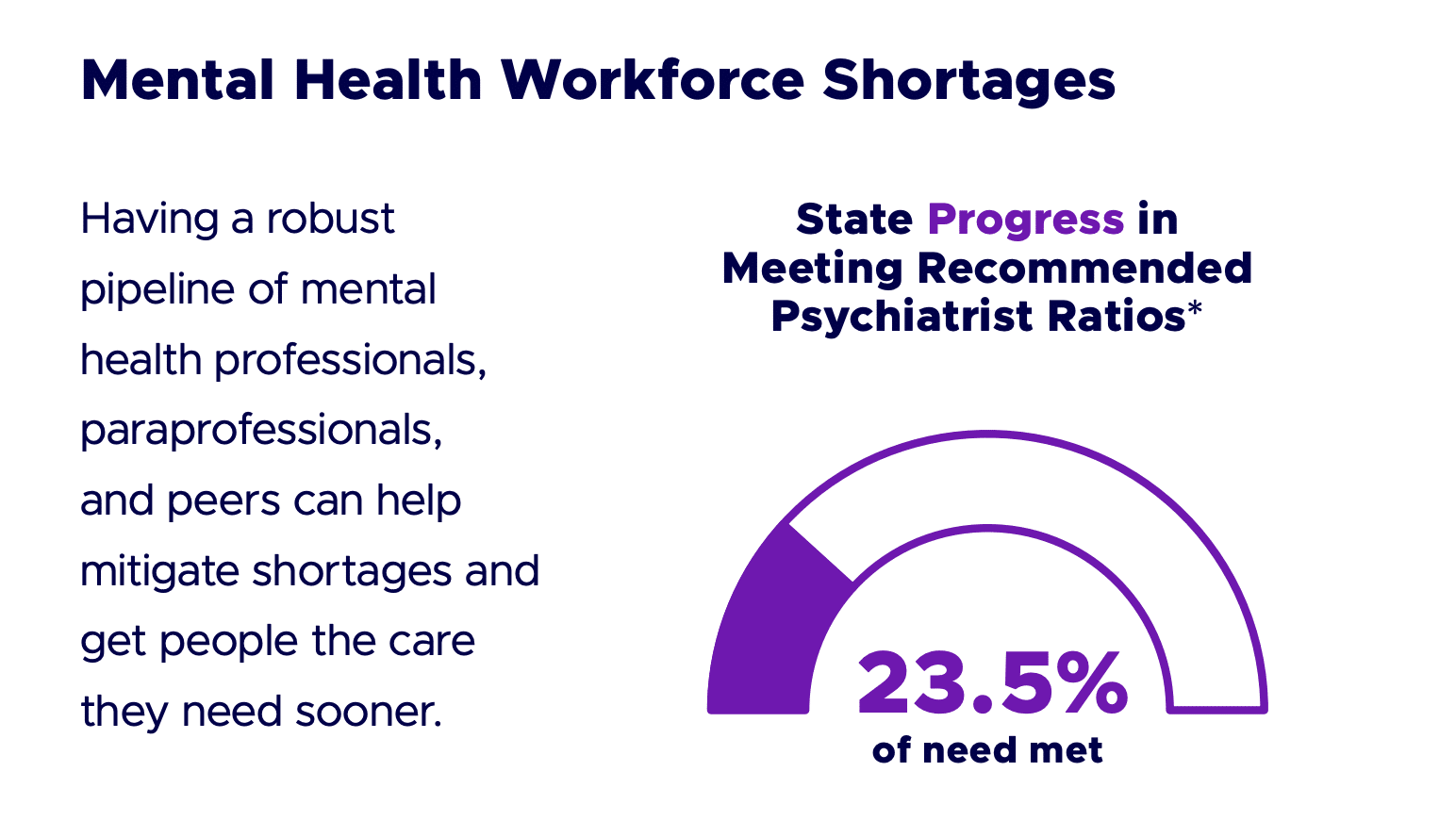
- The state is meeting just 23.5% of its psychiatrist need
- People go out-of-network 5.8 times more often for mental health care than for medical care
- California has not adopted key interstate licensure compacts
- There is no requirement to benchmark mental health reimbursement against physical health care
Source: California State Snapshot, The Workforce Report: Bridging the Mental Health Care Gap
Our own 2025 California workforce survey of more than 300 licensed and unlicensed providers reinforces this reality:
- Nearly 50% report physical or emotional exhaustion
- About 40% experience dread when thinking about work
- Only 52% expect to stay in their role over the next year
Burnout is widespread across provider types, with particularly high rates among county behavioral health staff. At the same time, providers identified what supports retention: feeling adequately trained and working within collaborative care models. These insights highlight that workforce challenges are not just about recruitment—they are about improving elements of working in this field to incentivize retention and professional fulfillment.
Where California has the opportunity to build
The report points to several areas where California can continue to progress to strengthen the workforce. Many of these efforts are already underway, but require further expansion to meet demand.
Expanding the workforce pipeline
California has invested in workforce development through programs like the Children and Youth Behavioral Health Initiative and the state’s Workforce Education and Training planning process. These efforts are growing a more diverse pipeline, but will need to scale significantly.
Strengthening the role of peers and paraprofessionals
Since SB 803 (2020) established Medi-Cal reimbursement for peer support specialists, California has taken meaningful steps to integrate lived experience into care teams. Building on that foundation, a Steinberg Institute-sponsored bill, AB 2138 (Krell, 2026), would further expand peers’ roles within Enhanced Care Management, particularly for individuals navigating transitions such as jail release or discharge from care. Expanding these roles aligns with evidence that peers improve engagement and outcomes while extending workforce capacity.
Improving reimbursement and insurance participation
Aligning reimbursement more consistently across systems is key to bringing providers in-network and expanding access. California has some of the strongest parity protections in the country through SB 855, but access enforcement challenges persist. AB 2011 (Hart, 2026), co-sponsored by the Steinberg Institute, would codify federal parity standards into state law to ensure continued enforcement and strengthen accountability.
Supporting integrated care models
The report highlights the Collaborative Care Model as a proven approach to improve outcomes and make better use of limited workforce capacity. California’s Medi-Cal program already covers these models, but commercial insurance plans are not required to cover them. Our workforce survey findings emphasize how collaborative care models can improve feelings of professional fulfillment and reduce burnout.
From policy to practice
California has invested in bold, innovative approaches to behavioral health. The next phase is making those reforms work in practice.
The Inseparable report reinforces what we are seeing across the state: implementation is where progress is realized or stalled—and workforce capacity will be a key factor in whether these efforts succeed.