
By Jillian Hughes
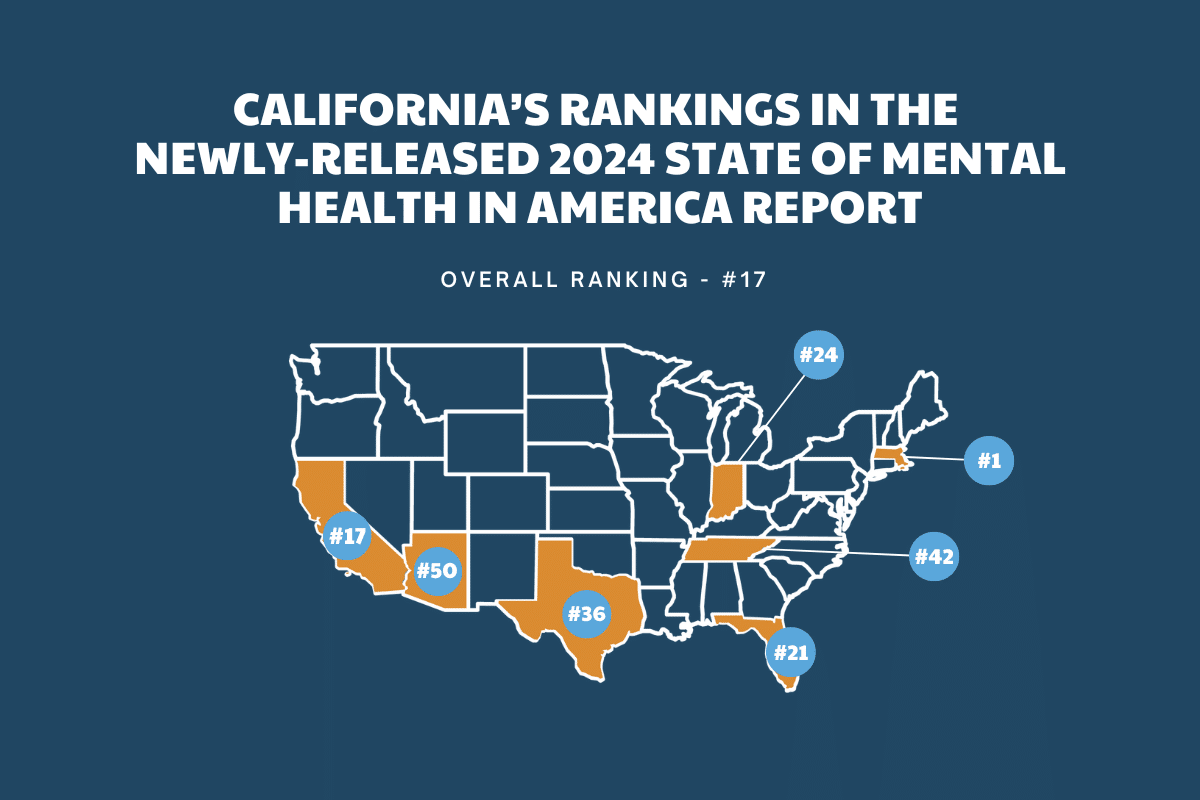
Mental Health America published its 2024 State of Mental Health in America report this week, an annual analysis of 15 different mental health measures in all 50 states and the District of Columbia. California ranked 17th overall in the analysis.
Mental Health America cautions that this year’s report cannot be compared to their report in previous years because the National Survey on Drug Use and Health (NSDUH) data used to generate the report went through methodological changes due to COVID-19.
Still, even taking into account this methodological caveat, 17 is California’s best and highest ranking in the 10-year history of MHA’s report.
“Since MHA began this report, California has invested billions of dollars into behavioral health workforce development and insurance coverage and affordability of mental health care in part through expansions to Medi-Cal,” said Maddy Reinert, Senior Director of Population Health at Mental Health America. “We also know that California has made large investments in prevention and early intervention and full-family supports which may contribute to lower prevalence rates of mental illness and higher rates of youth flourishing in the state.”
This year’s report includes particularly good news on youth mental health measures in California. However, a deeper dive into the report reveals there is still significant room for improvement, particularly in the areas of access to care and substance use disorder treatment.
 Good news for California youth
California’s best and highest ranking on an individual measure in the report is a number eight ranking on the “Youth Flourishing” measure. This measure is a new addition to MHA’s State of Mental Health in America report.
The report says “flourishing” is a positive indicator of mental health and well-being determined by the Health Resources and Services Administration’s (HRSA) Maternal and Child Health Bureau and it assesses children and adolescents’ learning, resilience, and self-regulation.
“Youth who were flourishing were those who always or usually showed interest and curiosity in learning new things, work to finish tasks they started, and stayed calm and in control when faced with a challenge,” the report states.
California’s high ranking on this indicator suggests successful state investment in schools, early childhood programs, and wraparound family supports.
In addition to high marks in flourishing, Reinert also pointed to good news for youth with private insurance in California. Only 6.8% of California youth who are covered under private insurance do not have coverage for mental or emotional difficulties – far better than the national average of 8.5%.
 Room for improvement on access to care measures
By contrast, the report suggests significant room for improvement in California on access to care measures. California is ranked 34 in overall access to care, a number that is a combination of eight different access measures in the report.
California’s worst ranking among these access measures is second-to-last (50 of 51) on the measure “Adults with SUD Who Needed But Did Not Receive Treatment.” The report says 82.77% of adults with a substance use disorder did not receive the treatment they need, higher than the national average of 76.9%.
The report lists an important additional limitation for this measure, however. SAMHSA, who collects the data used for much of the report, does not include receiving harm reduction services in their definition of substance use disorder treatment.
Harm reduction strategies are a major part of treatment for substance use disorders, particularly in California, and this data limitation may be contributing to California’s low ranking on this measure.
A mixed picture on workforce availability
California did particularly well on the report’s measure of “Mental Health Workforce Availability,” coming in at number 12, with a ratio of 240 people to every one mental health provider, far above the national average of 340:1. Reinert noted that this was particularly impressive given California has the largest population of any state, and added that, by comparison, California’s closest comparator in terms of population is Texas, which ranks number 50 on this measure.
However, other sources of federal data suggest a more nuanced picture of workforce availability in the state. California has the highest number of mental health Health Professional Shortage Area (HPSA) locations in the nation according to HRSA, at 588 areas.
A Kaiser Family Foundation analysis of HRSA data shows over 10 million people live in California’s 588 mental health care HPSAs, the second-highest number of people living in these areas of any state, after Texas.
Together, this data suggests that while California may appear to be doing well in workforce availability as a whole, good clinician availability is likely in major metropolitan, and wealthier areas, while more rural, poorer areas still struggle greatly with provider shortages.
Our work
Steinberg’s Vision 2030, an initiative to intervene in the mental health and substance use humanitarian crisis gripping California, seeks to address many of the issues highlighted in the 2024 State of Mental Health in America report. It prioritizes access to substance use disorder treatment for the homeless population and justice-involved population and also aims to modernize and strengthen California’s behavioral health workforce to meet the diverse needs of the entire state.